
So there I was three years ago, sitting at my kitchen table with Rob after putting Emma and Jake to bed, feeling all self-righteous about my latest parenting revelation. You know how it is – you read some article about kids being addicted to screens, look around at your house full of devices, and suddenly think you’re going to single-handedly save childhood as we know it. “We’re going tech-free,” I announced to Rob like I’d just discovered the cure for cancer. He looked up from his laptop and gave me that look. The one that says “here we go again with another one of Brenda’s phases.”
I’d been teaching high school for fifteen years at that point, watching kids get more and more attached to their phones, and I was convinced I could do better with my own children. Emma was eight then, Jake was five, and I figured if I acted fast enough, I could still save them from becoming screen zombies like their classmates. I had this whole vision – we’d be like those families you see in magazines, playing board games by the fireplace, going on nature hikes where everyone actually looked at the trees instead of trying to get the perfect Instagram shot. Rob just shrugged and said, “sure, honey, whatever makes you happy.”
The rules I set were pretty straightforward, or so I thought. No screens during the week except for homework. Weekend screen time limited to one hour, and only educational content. No phones until high school – this was back when I still believed I had that kind of control. Family dinner meant all devices in a basket by the front door. And here’s the kicker – Rob and I had to model good tech habits. Yeah, you can probably guess how well that last one went.
The first week wasn’t terrible, actually. We dragged out old board games from the hall closet – Monopoly, Scrabble, some weird dinosaur game Jake got for his birthday that none of us understood. Emma complained constantly, but she played along. Jake was easier to please back then; give him some pots and pans and he’d make “music” for hours. The house was definitely louder without everyone zoned out on their devices. More chaotic too. I forgot how much noise kids make when they’re not plugged in.
But here’s what I didn’t account for – my own addiction. And yes, I’m calling it an addiction because that’s what it was. Three days into our tech-free experiment, I’m sitting there watching Emma draw with actual crayons on actual paper, and I’m going crazy. My phone is buzzing with work emails, parent notifications from the school app, and God knows what else. I kept checking my watch every five minutes. When was the last time I looked at Facebook? What if someone needed me? What if there was some emergency I was missing?
The breaking point came during what should have been a peaceful family hike at Minnehaha Falls. Beautiful day, kids were actually getting along, Rob packed sandwiches – it should have been perfect. Except twenty minutes into the trail, I realized I’d left my phone in the car. Not on purpose, mind you. I just forgot it. And I swear to you, I had what can only be described as a panic attack. Heart racing, sweaty palms, this overwhelming need to turn around and go back. “I need to check on something,” I told Rob, which was complete nonsense because what exactly was I going to check on while hiking in the woods?
Rob, bless him, saw right through it. “You’re having phone withdrawal,” he said, not unkindly. The man works in IT – he’s seen this before. But I couldn’t admit it then. Instead, I spent the entire hike thinking about what I was missing. Had anyone texted me? Were there new photos on Instagram? Did someone comment on that post I made yesterday about our tech-free journey? The irony was lost on me at the time.
Meanwhile, Emma kept asking why I seemed so distracted, and Jake wanted to know why we couldn’t take pictures of the waterfall. Good questions from an eight-year-old and a five-year-old. Questions I couldn’t answer honestly because the truth was humiliating. I couldn’t enjoy a family outing without constant digital validation. How was I supposed to prove we’d been on this amazing nature adventure if I couldn’t post about it?
The whole experiment really fell apart during Jake’s spring break. I had papers to grade, lesson plans to write, and two kids bouncing off the walls because they were bored out of their minds. “Go draw something,” I’d tell them while I snuck time on my laptop. “Read a book.” “Play with those expensive toys cluttering up your rooms.” But after about thirty minutes of entertaining themselves, they’d be back, wanting attention I couldn’t give because I was trying to finish work.
That’s when Emma found me scrolling through Facebook during what was supposed to be our designated “creative play time.” She’d been showing me this elaborate story she’d made up with her dolls, complete with different voices and everything, and there I was, half-listening while checking to see who’d liked my post about our family game night. The look she gave me… it was like she was seeing me clearly for the first time, and she was disappointed. Eight years old and she could see through my hypocrisy better than I could.
“You’re always on that thing,” she said, and it wasn’t accusatory – it was just sad. Matter-of-fact sad, which somehow made it worse. I started to make some excuse about work, about needing to check important messages, but even as the words came out of my mouth, I knew they were lies. Nothing on Facebook was important. Nothing in my email couldn’t wait an hour. I was choosing the digital hit over being present with my daughter, and she knew it.
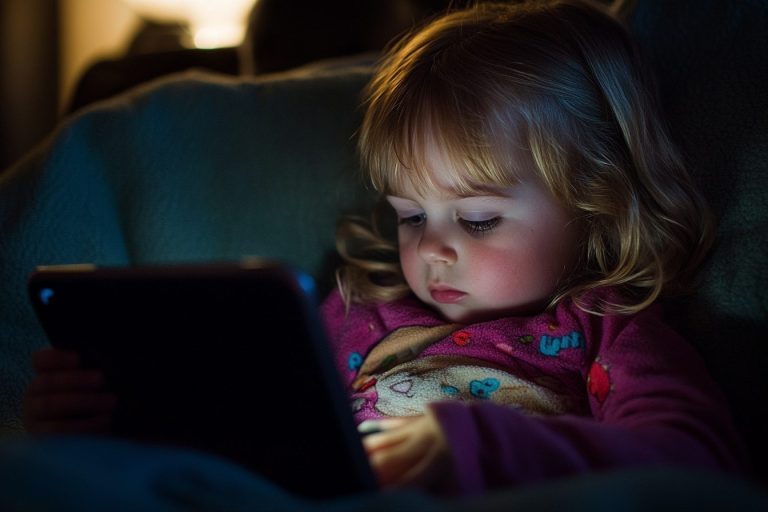
The final nail in the coffin of my tech-free experiment came about six weeks in. Jake had managed to figure out how to use Rob’s tablet – when exactly did five-year-olds become tech geniuses? – and I found him watching YouTube videos of other kids playing with toys. Not playing with his own toys, mind you. Watching other kids play with toys. It was like some weird meta-childhood experience that made no sense to me, but there he was, completely absorbed.
I should have taken the tablet away. That was the rule, after all. But here’s the thing – he was quiet. Peaceful. Not asking me for snacks every five minutes or fighting with Emma or making drum solos with kitchen equipment. And I had a pile of essays to grade and dinner to figure out and approximately zero energy for the meltdown that would inevitably follow if I confiscated his entertainment. So I let it slide. Just this once, I told myself. Just while I finish this one thing.

That “just this once” became twice became every day. Emma started getting screen time when she finished her homework early. Weekend educational content became weekend entertainment content became weekday entertainment content. The family dinner no-phone rule lasted until Rob got an urgent call from work that couldn’t wait, and after that, the basket by the door became more of a suggestion than a requirement.
Within two months, we were basically back where we started, except now I felt like a complete failure on top of everything else. Not only had I failed to create the analog childhood paradise I’d envisioned, but I’d also proven to myself and my family that I had zero willpower when it came to technology. My kids watched me break my own rules constantly. They saw me choose my phone over conversations with them. They learned that what mom says and what mom does are two completely different things.
The worst part was realizing that my relationship with technology was actually worse than my kids’. Emma might spend too much time on her tablet, but she could put it down when I asked her to help with dinner. Jake might have a tantrum when screen time was over, but he’d recover and move on to something else. Me? I checked my phone compulsively. I felt genuine anxiety when I couldn’t access it. I interrupted real-life moments to capture them for social media, which makes no sense when you think about it. I was living my life through a screen more than my children were.
That realization was pretty devastating, honestly. Here I was, trying to protect my kids from technology addiction while being completely unable to control my own usage. I’d lie awake at night scrolling through Instagram instead of sleeping. I’d check email during movies. I’d photograph our family moments instead of actually experiencing them, then spend twenty minutes choosing filters and writing captions while the actual moment passed me by.
Rob pointed out, not unkindly, that maybe the problem wasn’t the technology itself but how we were using it. Maybe going completely tech-free wasn’t realistic in 2021, especially with his job requiring him to be available and my teaching moving more and more online. Maybe the goal shouldn’t be elimination but moderation. Revolutionary concept, right?
So we tried a different approach. Instead of no screens, we set up specific times and places where devices weren’t allowed. Dinner table – phones stay in the kitchen. Family movie night – no second screening. Car rides under thirty minutes – no tablets unless someone was genuinely carsick. And here’s the important part – these rules applied to Rob and me too. No checking email during dinner. No scrolling while kids were trying to tell us about their day. No photographing every single family moment for the sake of content.
It’s been two years since our failed tech-free experiment, and honestly, we’re still figuring it out. Emma’s ten now and definitely more attached to her devices than I’d like, but she can also have conversations without needing to document them. Jake’s seven and loves his tablet time, but he also still plays with actual toys and asks to help cook dinner and rides his bike around the neighborhood. They’re not the screen-free children I thought I wanted, but they’re also not the zombie kids I was afraid they’d become.
The biggest change has been in my own behavior, though that’s still a work in progress. I put my phone in another room when the kids are telling me about school. I try not to post about family activities while they’re actually happening. I’ve learned to sit through boring parts of children’s movies without needing digital distraction. Small victories, but they feel significant.
What I learned from this whole disaster is that you can’t parent away problems you haven’t solved in yourself. My kids don’t need me to be perfect with technology – they need me to be honest about my struggles and to keep trying to do better. They need to see that adults can recognize their own bad habits and work to change them, even when it’s hard. Especially when it’s hard.
The other thing I learned is that technology isn’t inherently evil, which feels obvious now but wasn’t so clear to me three years ago. It’s a tool, and like any tool, it can be used well or poorly. Teaching kids to use it well probably matters more than teaching them to avoid it entirely, especially since avoiding it entirely isn’t really possible anymore. Emma’s homework is online. Jake’s school uses educational apps. Rob’s job requires him to be connected. This is just the world we live in now.
So yeah, my grand experiment in tech-free parenting was a complete failure. But maybe that failure taught me more than success would have. It forced me to confront my own relationship with technology, which was honestly more problematic than my kids’ relationship with it. It made me realize that modeling good behavior is harder than setting rules, but it’s also more important. And it reminded me that parenting is mostly about figuring things out as you go and hoping you don’t screw up too badly in the process.
These days, our approach is what I call “intentional tech use,” which sounds fancier than it is. We try to make conscious choices about when and how we use devices. We talk about why we’re reaching for phones and whether that reason is worth missing whatever’s happening in real life. We have conversations about how different apps and games are designed to keep us hooked, and why that’s not necessarily good for our brains. It’s not perfect, but it’s better than the all-or-nothing approach I started with.
The kids still get too much screen time sometimes. I still check my phone more than I should. Rob still takes work calls during family time occasionally. But we’re all more aware of these habits now, and awareness is the first step toward change, right? At least that’s what I tell myself when I’m feeling guilty about letting Jake watch YouTube for two hours while I graded papers last weekend.
If you’ll excuse me now, I need to go convince Emma to play a board game with the family. I’m aiming to get through an entire game of Monopoly without checking my phone once. Wish me luck – I’m going to need it.

Brenda’s a Minneapolis teacher and mom trying to raise kids in a world glued to devices. Her posts mix honesty, guilt, and humor as she navigates parenting, teaching, and losing daily battles against technology. She’s not a technophobe—just a realist with Wi-Fi exhaustion.
0 Comments